 EN
EN

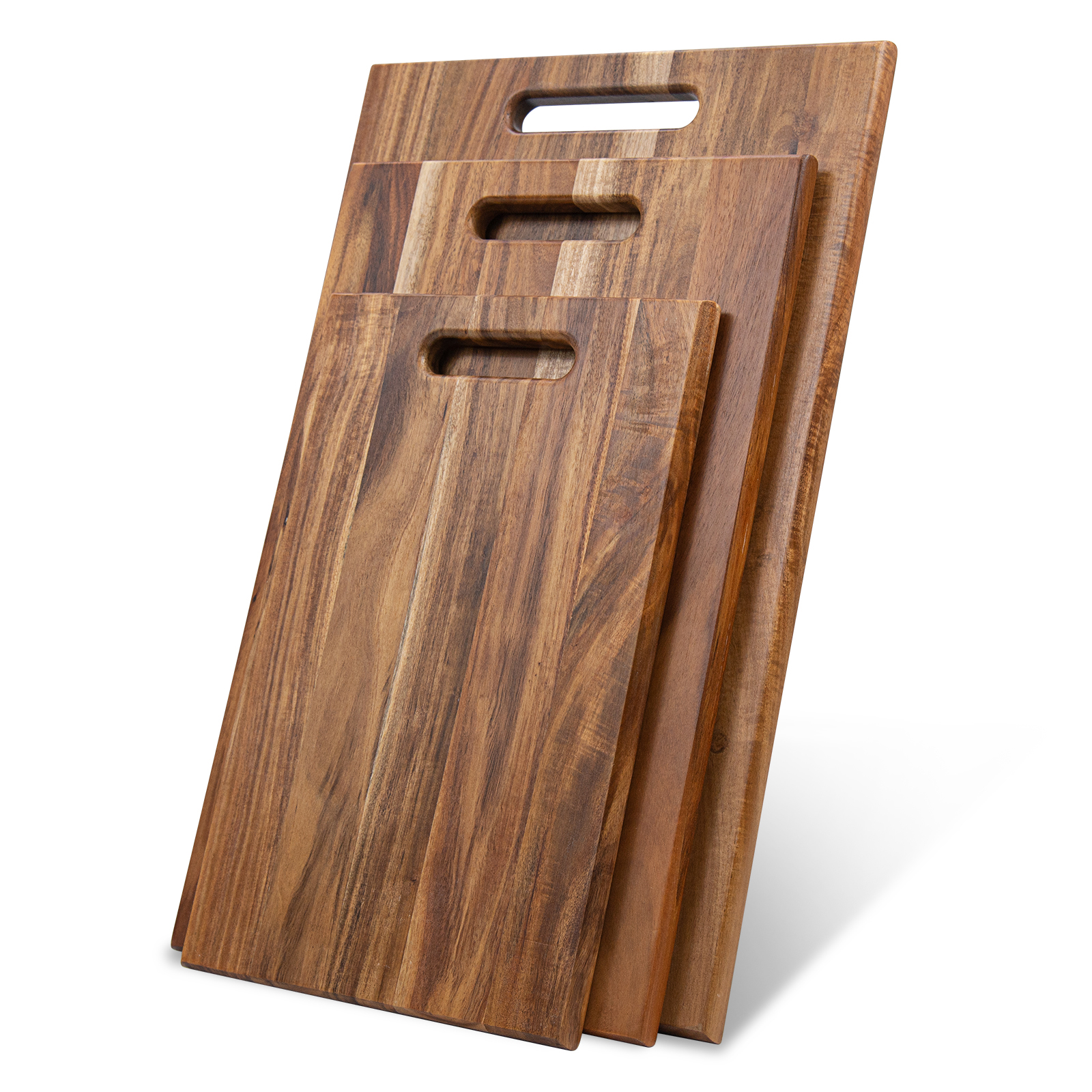
Superior Durability and Scratch Resistance for High-Volume Use
Janka Hardness Benchmark: Acacia vs. Maple, Walnut, and Bamboo
Acacia wood cutting boards excel in high-traffic kitchens thanks to their exceptional hardness—measured at over 1700 lbf on the Janka scale. This surpasses maple (1450 lbf), walnut (1010 lbf), and bamboo (1380 lbf). Its dense, interlocking grain resists deep knife scoring and splitting, preserving a smooth, consistent cutting surface even after years of aggressive use. Unlike softer woods that develop permanent grooves, acacia’s structural integrity holds up under daily cleaver work and repetitive chopping—making it a trusted choice for commercial kitchens.
Real-World Performance Under Daily Heavy Chopping and Cleaver Work
In professional settings, acacia consistently outperforms softer alternatives like teak and rubberwood, showing minimal visible wear after sustained heavy use. Its combination of high density and natural elasticity allows it to absorb impact without permanent deformation—critical when using cleavers or processing large volumes of food. This resilience translates directly to food safety: shallow cuts mean fewer harborage points for bacteria, reducing sanitization challenges and extending service life between replacements.
Natural Water and Bacterial Resistance in Demanding Kitchen Environments
Tannins and Dense Grain: Dual Defense Against Moisture Absorption and Microbial Growth
Acacia’s natural resistance to moisture and microbes stems from two key features: its exceptionally dense grain structure and high tannin content. Tannins—naturally occurring polyphenolic compounds—bind with proteins and polysaccharides in wood cells, effectively limiting water permeability. Paired with tight cellular packing (density ~900 kg/m³), this creates a dual barrier that slows liquid ingress and restricts microbial colonization. The result is a surface that stays drier longer, requiring less frequent chemical sanitization and maintaining hygiene standards across shifts.
Lab-Validated Moisture Uptake Comparison with Cherry and Bamboo (USDA Data)
USDA testing confirms acacia’s superior moisture management: after 24 hours of submersion, acacia absorbed just 4.2% moisture by weight—less than half of cherry (8.7%) and significantly less than bamboo (11.3%) [USDA Forest Service, 2022]. This low uptake correlates directly with reduced warping risk and lower bacterial retention potential, supporting long-term structural reliability and sanitation compliance in high-humidity environments.
Exceptional Stain and Acid Resistance from Surface Density and Grain Structure
Acacia’s dense surface and tightly packed grain form a natural shield against staining and acid damage. Deeply pigmented foods—like berries, turmeric, and red wine—struggle to penetrate beyond the surface, while acids from citrus, vinegar, and tomatoes are less likely to etch or discolor the board. This inherent resistance helps maintain both appearance and functionality, even with daily exposure to demanding ingredients.
Dimensional Stability and Warping Prevention Under Thermal and Humidity Fluctuations
Quarter-Sawn Acacia: How Grain Orientation Enhances Long-Term Flatness
Acacia’s dimensional stability—especially in quarter-sawn form—makes it uniquely suited for environments with fluctuating humidity and temperature. Cutting perpendicular to the growth rings minimizes lateral wood movement by aligning moisture absorption pathways vertically, dramatically reducing cupping or bowing. Compared to flat-sawn maple or bamboo—which swell and contract more readily—quarter-sawn acacia retains flatness through steam exposure, dishwashing cycles, and seasonal shifts. This consistency is essential for maintaining safe, level food contact surfaces over time.
Heavy-Duty Design Features That Maximize Functionality and Food Safety
Optimized Thickness (1.5″), Juice Grooves (3/8″), and Reinforced Edges for Professional Workflow
Professional-grade acacia cutting boards integrate three functional design elements proven to enhance safety and efficiency: a 1.5-inch thickness delivers mass and stability under cleaver strikes; a 3/8-inch-deep juice groove effectively channels liquids away from the cutting surface, lowering cross-contamination risk; and micro-beveled or rounded reinforced edges eliminate splinter-prone crevices, simplifying cleaning and extending board life. Together, these features support faster prep workflows, reduce downtime for maintenance, and uphold rigorous food safety protocols.
Frequently Asked Questions
Why is acacia wood preferred over other types of wood for cutting boards?
Acacia is renowned for its exceptional hardness, durability, and resistance to moisture and microbial growth, making it ideal for high-volume kitchens.
How does acacia's density help in reducing bacterial contamination?
The dense grain minimizes knife grooves, reducing harborage points for bacteria and extending sanitization intervals.
Can acacia cutting boards withstand heavy cleaver impacts?
Yes, acacia's combination of density and elasticity allows it to absorb impact without permanent deformation.
Does acacia wood require special maintenance?
No, its natural water and bacterial resistance reduce maintenance needs, although regular cleaning and proper drying are recommended.
Is acacia more warp-resistant compared to other woods?
Yes, especially in quarter-sawn form, acacia exhibits superior dimensional stability under humidity and temperature fluctuations.
Table of Contents
- Superior Durability and Scratch Resistance for High-Volume Use
- Natural Water and Bacterial Resistance in Demanding Kitchen Environments
- Exceptional Stain and Acid Resistance from Surface Density and Grain Structure
- Dimensional Stability and Warping Prevention Under Thermal and Humidity Fluctuations
- Heavy-Duty Design Features That Maximize Functionality and Food Safety
-
Frequently Asked Questions
- Why is acacia wood preferred over other types of wood for cutting boards?
- How does acacia's density help in reducing bacterial contamination?
- Can acacia cutting boards withstand heavy cleaver impacts?
- Does acacia wood require special maintenance?
- Is acacia more warp-resistant compared to other woods?